

The Sixteen: An Immortal Legacy
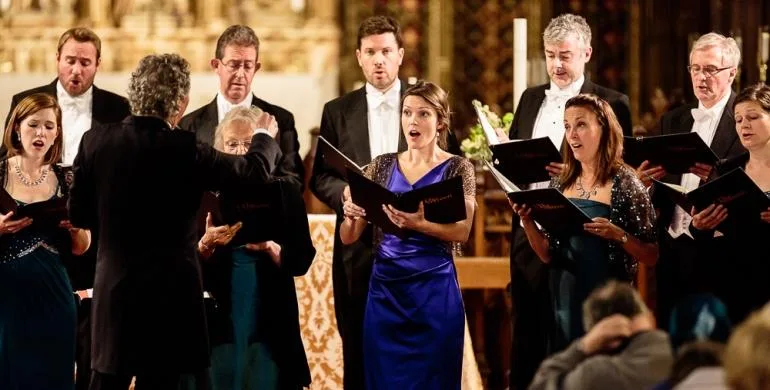
Thomas Tallis and William Byrd are hardly household names, but it is sobering thought that their polyphonic masterpieces from the 16th century would, in all probability, have languished in complete obscurity if not for Harry Christophers’s enthusiasm for this previously neglected period in British musical history, leading to the formation of the starkly named The Sixteen in the late seventies to perform their work. Christophers’s choir has continued to morph and develop over the years and, as evidenced by the varied and carefully curated programme at the Cathedral, it no longer limits itself to performing 16th century music (nor, incidentally, are there only sixteen of them) but the name has stuck.
Nonetheless, given the sublime elegiac beauty of the opening set of tunes from Tallis (for Archbishop Parker’s Psalter since you ask) it’s clear that their primary mission continues to be showcasing the finest Tudor music - apart from Tallis we heard the likes of Thomas Morley, William Byrd and John Shepherd – while also demonstrating that contemporary pieces can work well alongside their more established repertoire. A clear highlight of the evening were the spirituals from Michael Tippett’s A Child of our time, revealing how profoundly religious music can influence secular choral pieces, while contemporary composer James Macmillan’s quirky Sedebit Dominus Rex proved how far the choir are willing to push the boat out. The Sixteen’s stirring rendition of Benjamin Britten’s jaunty dances from Gloriana ratcheted up the momentum, adding power and intensity to the exacting purity we had witnessed throughout the performance, with a further four tunes from Tallis rounding things off.

A minor gripe, it has to be said, was the extraordinarily uncomfortable seating that would have made a lesser performance akin to an endurance test. I don’t think they’ve been changed those seats in the last twenty years, and though I’m very aware that in a house of worship we are supposed to have other, bigger, concerns than comfort of our bony bottoms, a reminder to bring along a cushion wouldn’t have hurt. Less forgivable was the spectral form of a two man camera crew, clattering about between the aisles of seating. Far enough away from me to be no more than a peripheral nuisance, for those unfortunate enough to be sitting close to them it was (as those folks volubly articulated during the interval) an intrusive distraction that compromised their enjoyment. Lord knows (I imagine, given the venue) whether these dunderheads were working for the festival or the choir, but their presence was little short of a disgrace.
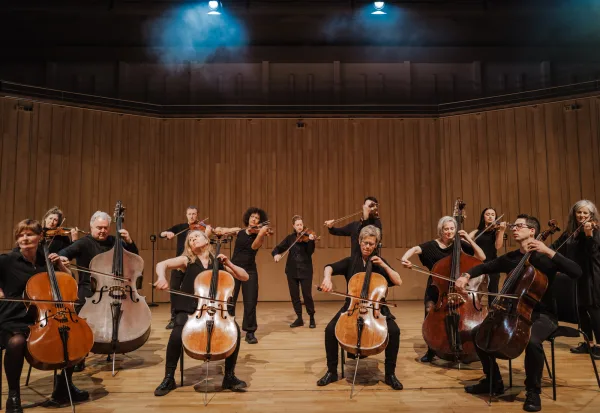
All of which is an accurate summary, but a woefully inadequate, outline of what this master class actually felt like – but then how do you, in words, convey the almost transcendental heights the human voice can reach when entrusted to such gifted singers? This wasn’t an evening about individual songs, any more than it was about individual singers, but of the effect of the whole. It was telling that the names of the choir were not listed in the programme - a decision that was mirrored in their unassuming stage presence. This was not a collection of singing superstars jostling for position, however brilliant the individuals no doubt are. It was an eighteen strong collective, marshalled expertly by Harry Christopher, coming together to produce the richly expressive tapestries that Tallis, his contemporaries, and his acolytes, have bequeathed to us.
I am not a person of faith, but I have to say that hearing Talllis’s exaltation to God within the glorious setting of the Cathedral was unnervingly close to a spiritual experience. The Sixteen took his music and sent it aloft, up towards the God he and his contemporaries so earnestly looked to for salvation, filling a house built in His honour an astonishing five hundred years before Tallis started composing. It certainly made sense of the music, and why, in a pre-literate age, it was such an effective tool in inculcating a religiosity in those that heard it. I suppose the jury is still out as to whether this was instructive or a just a confidence trick – Tallis and Byrd were both notorious expedient at a time of great religious turmoil – but in the capable hands of The Sixteen, it certainly had me wondering at my place in the universe, and all that sort of thing. There is a pleasing symmetry in the thought that Tallis wrote at what is now the mid-point of the Cathedral’s history, and that after all this time we are still listening to his music. It made it a peculiarly apt venue to celebrate what is, indeed, an immortal legacy.