
Death on the Nile
Sumptuous costumes, moody lighting, dramatic sound, superb design and a fine cast tautly directed all add up to grand night out
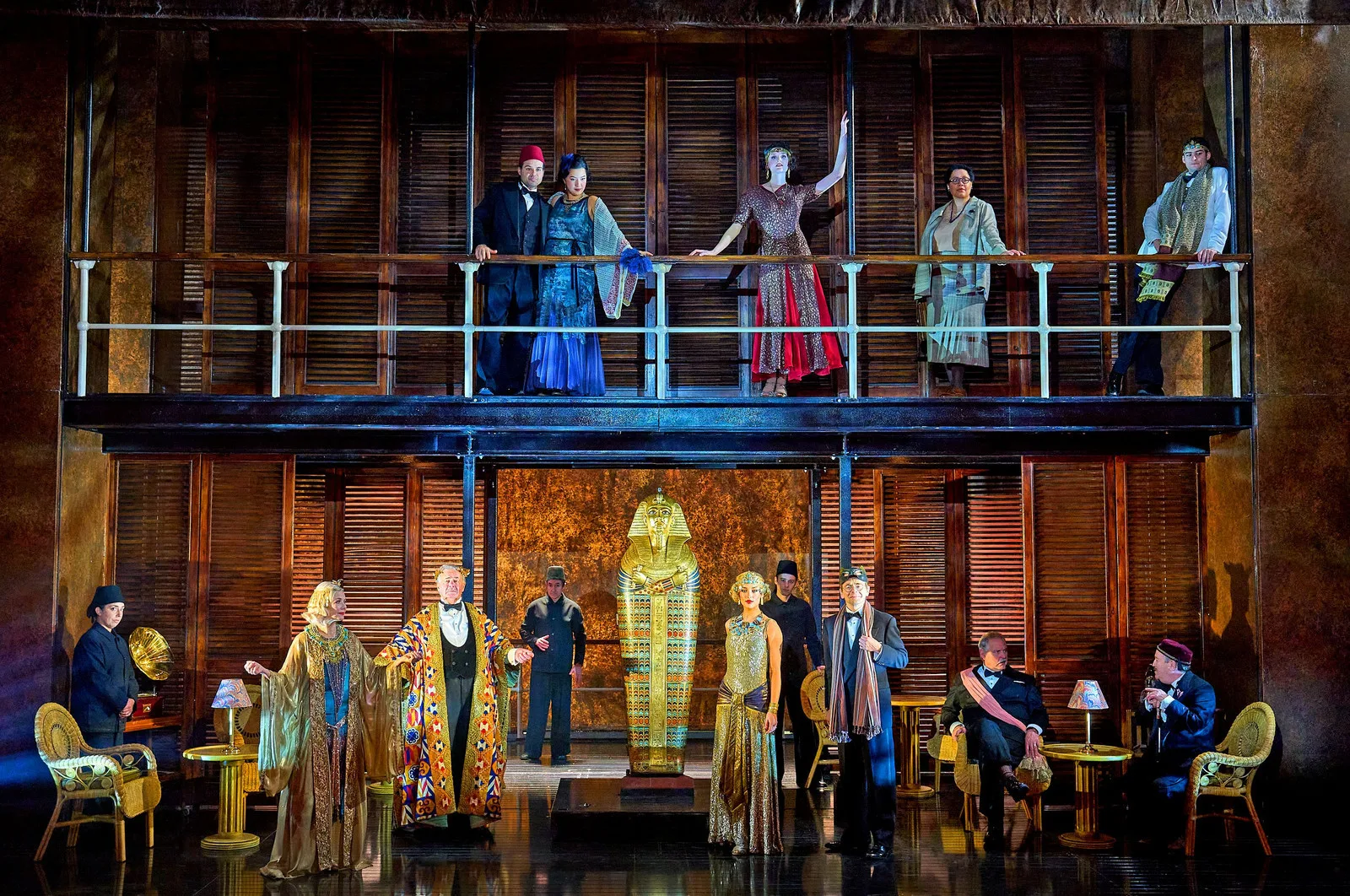
Following last year’s Murder on the Orient Express, Ken Ludwig has turned his considerable ability to condense the essence of Agatha Christie, streamlining the labyrinthine plot of Death on the Nile. The passenger list has been whittled down to less than a dozen, the death toll reduced and action restricted almost entirely to on-board the paddle steamer.
A couple of scenes set in London, most notably in the British Museum, repurpose the Nile voyage as the unlikely means to return an ancient sarcophagus, serving also to introduce the characters involved. Centre stage was Libby Alexandra-Cooper in a remarkably assured debut as the heiress Linnet Ridgeway. Equally impressive was Nadia Shash, stepping up from the ensemble cast to replace Glynis Barber. As a fan of Blake's 7, I'll admit to a twinge of disappointment at Barber's absence, but you really wouldn't have known that an understudy was in play. Nye Occomore manages to present Simon as both charming and slippery, but it’s Esme Hough, as his spurned lover, that commands the stage whenever she appears. Displaying an emotional intensity that teeters close to unbalancing the tone of the play, it’s all eyes on her whenever she appears.
At the centre of attention otherwise is, of course, Poirot, the Belgian detective on holiday. Mark Hadfield gives him a mischievous twinkle and an accent thick enough to stand a spoon in. Arch, without lapsing into comedy, his best scenes are with Bob Barrett's Colonel Race, who looked to be having great fun throughout.

The whole cast, in fact, do their best with the hand dealt. If Ramses and Atticus Praed, Septimus Troy, Rosalie Otterbourne and Annabelle Pennington fade into the background it’s through no fault of the actors playing these underwritten parts. The key shortcoming of this adaptation is that too many characters have neither personality to be murdered nor the guts to be a killer. So by the time someone is murdered – and we do take a while to get there – their card has been marked for some time. Ludwig has done his best to rehash the plot for the stage, but an awful lot of narrative has been necessarily dispensed with, which leads to an awful lot of exposition in its place. Fortunately, Lucy Bailey's sprightly direction moves things along nicely and, apart from a couple of weird slow-motion distractions, does so with unfussy economy.
She is helped by Mike Britton's superb split-level set design that is arguably the real star of the show. Straightforwardly delightful to look at, it also has the practical effect of characters constantly, furtively moving and talking just out of sight and earshot of anyone else. With an economy of movement, Bailey has them appearing and disappearing with the precision of chess pieces. Christie’s stories are as much about who gets it as whodunnit, so I had no problem at all with the build-up to the first crime.
Indeed, Poirot seems to need very little time, or evidence, to work out the latter, and while the final, traditional drawing room scene is gently mocked, that doesn't entirely excuse the clunkiness with which it's introduced. Too many of the paper-thin characters have no real motive to carry out the crime, leaving it a little too obvious who the murderer must be. The consequential anticlimactic ending is where the play lets itself down. That said, if you know the resolution Christie provided, you'll appreciate Ludwig had his work cut out making it dramatically satisfying. Restaging the crime while Poirot explained it went some way to injecting interest, though it also confirmed its inherent implausibility.
The trick to Agatha Christie plays, whether written by her or adapted by someone else, is to avoid taking them too seriously. Inherent implausibility is at the heart of all her stories, and Ludwig knowingly leans into this. If you add the window dressing of Sarah Holland's sumptuous costumes, Oliver Fenwick's moody lighting and Mic Pool's dramatic sound to a fine cast tautly directed, you have a grand night out