Ali Smith
Smith is especially skilled at writing in a way that feels formally restless and alert to language itself.
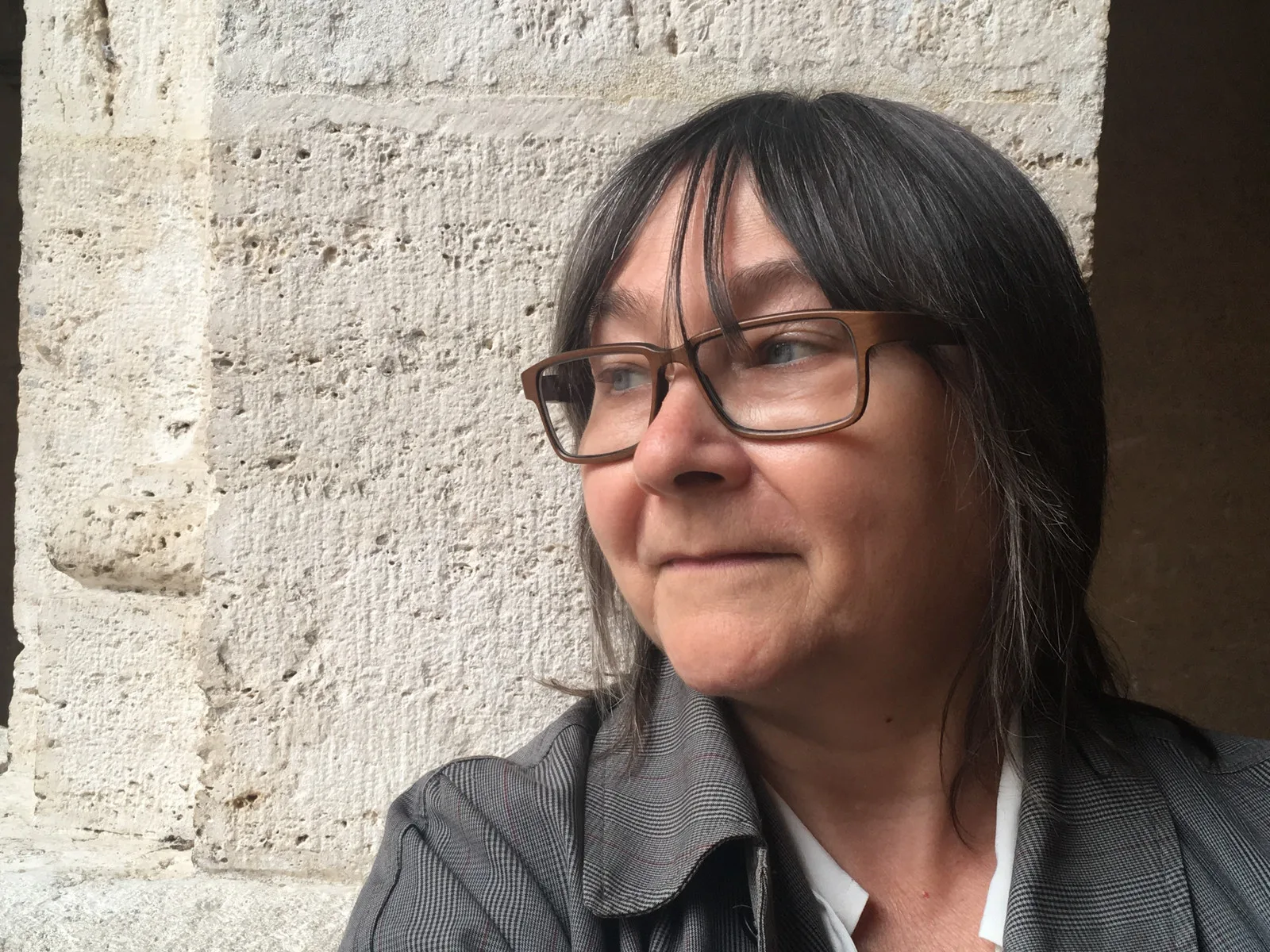
Ali Smith is a regular visitor to Norwich. As a UNESCO City of Literature Visiting Professor, she has appeared at UEA Live panel talks many times, and as a patron of the National Centre for Writing she has also given readings and discussions there. With twenty books now to her name - only six fewer than Muriel Spark, as noted in conversation with her longtime friend and Queen Mary University professor Mark Currie - Norwich feels like a familiar stop on her literary circuit whenever a new work is published.
Her newest novel, Glyph, is the second instalment in the sequence that began with Gliff. Like much of Smith’s work, it returns to the question of what literature and storytelling can do in moments of political and social crisis. Just as the Seasonal Quartet is shaped by Brexit, COVID-19, and the rise of Trump, Glyph gestures towards the war in Gaza, weaving together anxieties around displacement, dehumanisation, and moral responsibility with a narrative about children inventing ghost stories to soften the horror of an old woman’s account of a man she discovered in the 1940s, so badly damaged that his head had disappeared. In her talk, Smith quoted Toni Morrison: “[art] has to be both: beautiful and political at the same time. I’m not interested in art that is not in the world.” That insistence on writing as both aesthetic practice and ethical engagement feels central to her work, and to its force.
At the start of the discussion, Mark Currie drew a distinction between the words “gliff” and “glyph”. Gliff, with an “i”, suggests something fleeting - a glimpse, a flicker of perception, even the thawing of snow. Glyph, by contrast, points to something carved, fixed, and inscribed. That contrast becomes a useful way into the two novels: one concerned with ephemerality and perception, the other with memory, inscription, and what endures.

Smith is especially skilled at writing in a way that feels formally restless and alert to language itself. Critics often describe her as an inventive novelist who works through association rather than linear plot, using puns, shifts in register, repetition, and digression to build meaning through echo and return. The effect is often playful, but never incidental - form itself becomes a way of thinking. She has sometimes been criticised for limited “world-building” or for being “too clever-clever”, as she acknowledged in the talk, yet it is precisely this formal experimentation that gives her work its distinct voice, and places her, not unconvincingly, in the line of writers often associated with Virginia Woolf.
Her fiction resists straightforward realism because it is trying to register what lived experience under pressure actually consists of: distraction, fragmentation, interruption, and the effort to hold meaning together as it begins to slip. Later in the talk, speaking about attention, reading, and the act of staying with literature, Smith remarked that “language is the basis of health.” It felt like a condensed statement of her wider project: language not simply as communication, but as a means of sustaining empathy and human connection in increasingly unstable times. She also spoke about AI, phone culture, and the fragmentation of attention, suggesting that storytelling - especially older forms like the ghost story - still offers a way of reuniting what feels broken apart.
To end on a personal note, I queued in the baking heat to get my book signed afterwards, and seeing Ali Smith hold people’s hands, blow kisses, call them “darling”, and smile with such warmth was exactly what I had hoped for. It’s the kind of openness you want from a writer whose work is so concerned with care, attention, and connection.