Ideal
It was all a bit bonkers, the surreal queasiness of the TV show trumped by the need to make an audience laugh out loud. And in fairness, laugh they did.
venue
Twenty years ago, tucked away on BBC3, the first of seven series starring Johnny Vegas was broadcast, to public and critical acclaim. "Ideal" as in, I presume, "I deal" was a flat-bound tale of Moz, a small-time drug dealer living in Salford. The increasingly surreal comedy derived from his regular unhinged visitors and the nihilistic, amoral universe in which they lived. In the spirit of full disclosure, I should say that until recently this was all news to me, as I was unaware that anyone ever actually watched BBC3 back in the noughties. I've since been doing my best to catch up on iPlayer and thank goodness I did - this was a show that owed much of its charm to nostalgia for fans, notwithstanding that the play is notionally a standalone production.
Here's the thing. Despite respectable viewing figures, the show was unceremoniously cancelled after those seven series, leaving both audience and characters hanging in mid-air. The show's creator and writer, Graham Duff, was understandably miffed at having to abandon his planned conclusion to the narrative, and while the live version doesn't quite resolve those loose ends, it is at least a last hurrah for much-loved characters. The fact that all but Lucy Farrett, as Moz’s girlfriend, are reprising their roles is key to the success of the show. For fans, I don't think it would have otherwise worked at all. Apart from Vegas's return as Moz and Duff's return as neighbour Brian, we got Ben Crompton as the perennially paroled Colin, Ryan Pope as Noel Gallagher channelling Psycho Paul, Joanna Neary’s (reformed) necrophiliac Judith, and Emma Fryer as self-serving, street-smart Tania.
It's fair to say the plot of the play - and I use the term advisedly - is understandable without having seen the TV incarnation, but even fairer to say fans of the BBC3 iteration will have most of the fun. For all Duff's attempts to write a self-contained story, he looks to have been constrained by the availability of the original actors. I think that was a cameo from Nicola Reynolds on the phone, and I'm sure that was Tom Goodman-Hill taking the second call, but their characters were sorely missed on stage. No less disreputable, they were at least grounded in reality, offering a counterpoint to the lunatics in the surrounding asylum. Without them, the antics of Colin and Judith, fun though they were, quickly veered towards pantomime. Oddly, Duff has underwritten his own part while Moz largely occupies the eye of the storm. He's very nicely played by Johnny Vegas but I thought it was telling that he seemed to have most fun, and elicited the biggest laughs, when he stumbled over his lines. All in all, it's the relationship between Psycho Paul and Tania that intrigued the most, not least as Emma Fryer was far and away the most convincing performer on stage.

The narrative was unapologetically ridiculous, and there's nothing wrong with knockabout fun, but I was disappointed Duff didn't manage to better integrate what was, barring a token party scene, effectively two separate tales. The action switched back and forth between two bare-bones settings - Moz's flat and Paul's headquarters. This seemed an odd plotting decision from Duff on two counts. In the earlier series the action revolved entirely around Moz's flat, and while it was perhaps inevitable that the show would open up, I'd have thought the spirit of those early episodes was perfectly suited to stage adaptation. Instead, we not only went back and forth between locations, but did so often, requiring patience from the audience while scenes were reset, and a suspension of disbelief as the actors clambered off stage in half darkness. I wonder if Duff, more used to writing for the screen, simply didn't consider the practical ramifications of what he had written. It certainly looked that way when it came to the surreal vignettes that, on a touring show's budget, didn't convince as I imagine he hoped.
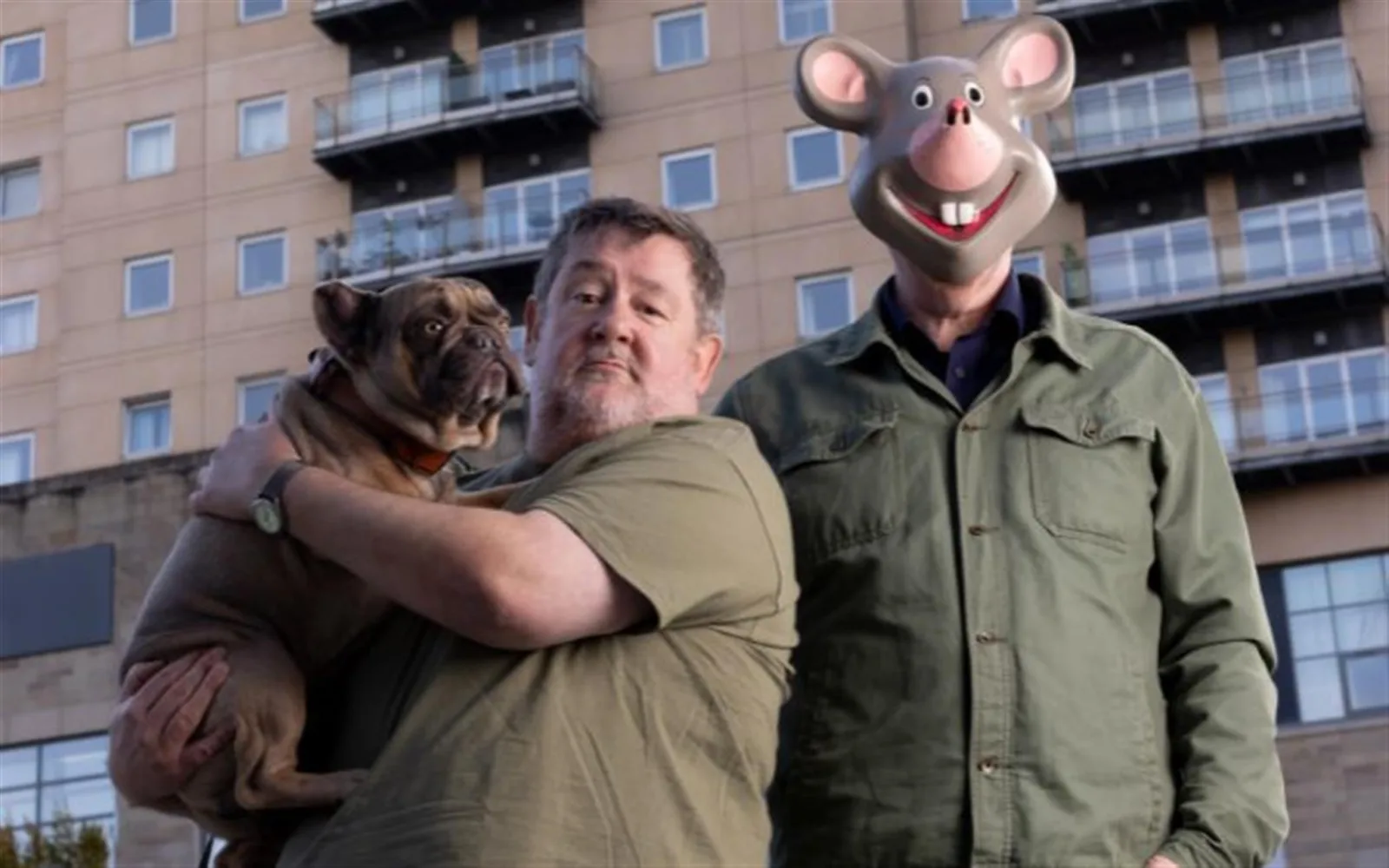
In short, it was all a bit bonkers, the surreal queasiness of the TV show trumped by the need to make an audience laugh out loud. And in fairness, laugh they did, so perhaps I'm just a tiresome theatre bore, balking at the whoops of delight and applause when each familiar face popped up - this isn't America for goodness' sake - and there's no denying audience and performer alike obviously had a fine old time. There's no great shame in offering up a celebration of a show that delighted folk, and if the seats were packed with those in the know (until those seats were vacated for a standing ovation) then everyone's a winner. At least Duff has gone to the bother of writing new material, unlike John Cleese, content to oversee the stitching together of old episodes of Fawlty Towers for its West End run. For me, however, the evening was epitomised by the curtain call revelation that Cartoon Head was played by whoever wasn't otherwise on stage. It was essentially harmless fun, but once the mask had slipped its lack of substance was revealed. Was it enjoyable - certainly. It just wasn't ideal.
Only a few days ago I mentioned the range of shows on offer at Epic - from Killer Cults to dodgy mushrooms is how I put it, in the context of hosting a new comedy night. Ideal was staged in co-operation with the Arts Centre, but nonetheless was yet another instance of the venue bringing something new to a part of the city too easily overlooked. That, above all else, is something to be celebrated. Rhys James would, no doubt, be delighted to hear that this time, they even switched off the bar lights.