

Hamlet
This was a noble attempt to breathe fresh life into a play we know too well to enjoy as the author intended. It was a feast for the eyes and, with the text stripped to the bone, offered up an unusually urgent and fast-moving version. Whether that justifies a staging conceit that strained credulity is a moot point.
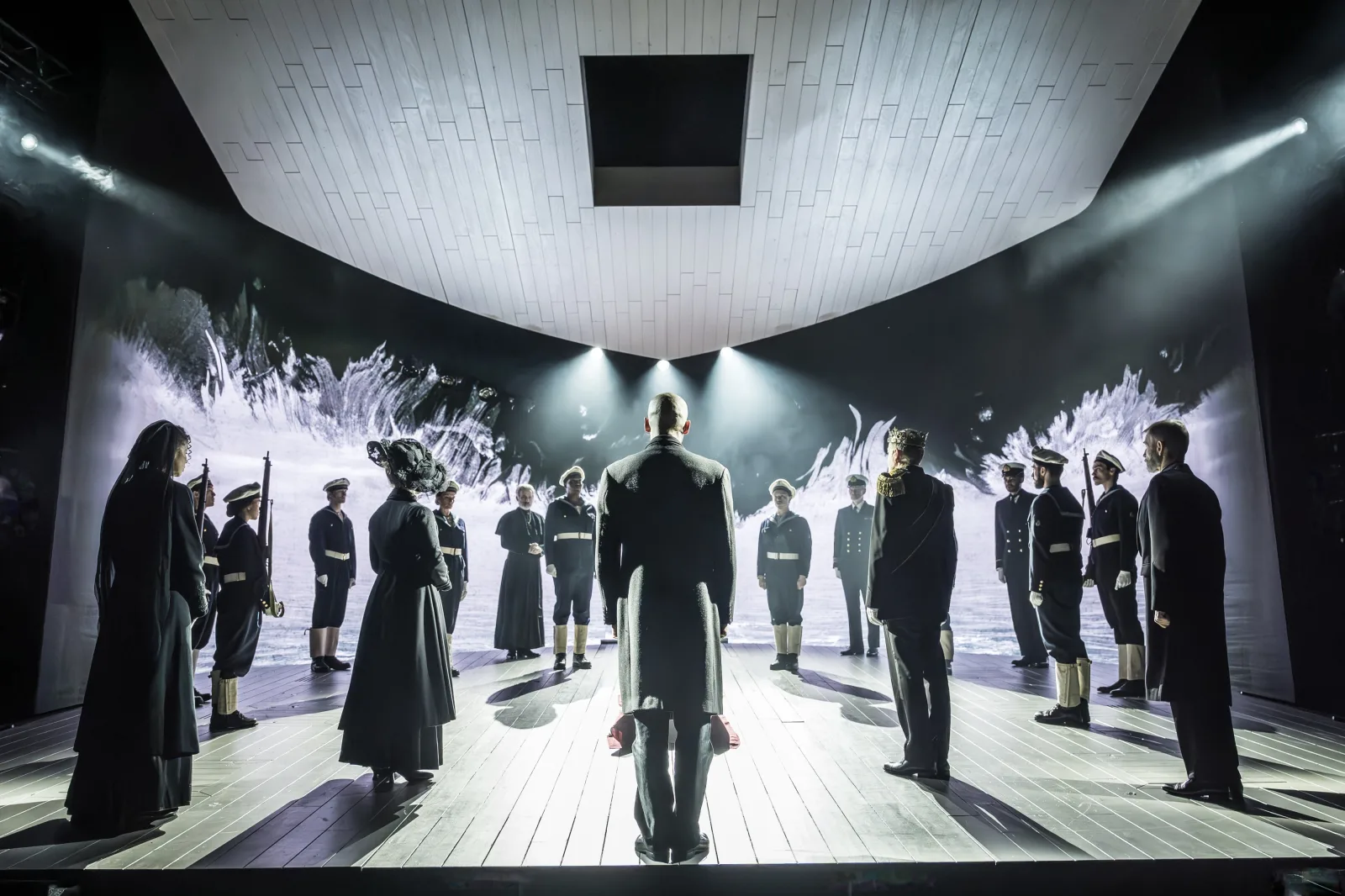
The commercial reality of staging Shakespeare inevitably means that his best known plays will pop up time and again. With only A Midsummer Night's Dream staged more often than Hamlet, despite the latter also being the longest, the tale of something rotten in the state of Denmark is bound to inspire reimagining. Rupert Goold's bold departure from the text is to set the action on the deck of the Titanic, only hours before disaster is due to strike. Should there be any doubt about this, the striking visuals of this production are kicked off by the ominous and relevant day – the 14th April, 1912 – when the iceberg hit. A ticking digital clock, mounted either side of the stage, then counts down the hours and minutes until the ship goes down.
This production has already had a long and successful run at Stratford and reviews, indeed objections, suggest this effectively condenses the plot of Hamlet to a timeframe of a few hours. I think this entirely misses the point of Goold's thinking. No one is surely suggesting the machinations of the Danish Court take place while folk struggle with life jackets or dance the night away in blissful ignorance of their fate. Rather, Goold's extended metaphor is that we are watching the inevitable collapse of a corrupt regime – it is a sinking ship from the start. As surely as a collision with an iceberg leads to the boat going down, Hamlet's handsomely staged meeting with his ghostly father will lead, with tragic inevitability, to a huge pile of dead bodies.
I wonder if Goold is also playfully acknowledging the audience's reaction to a play that can hold few surprises. Our relationship with any of Shakespeare's better known works is entirely different from the people he wrote it for. They were watching and wondering what happens next. We (spoiler alert) know everyone dies, as surely as we know the ship is going down.
How successfully Goold pulls this off is another matter, and the production does vacillate between acknowledging and ignoring its setting. King Hamlet is buried at sea, the cast are clothed in Victorian dress, Rosencrantz and Guildenstern are an American couple and Polonius is dispensed with a pistol. Yet the appearance of the gravedigger is never satisfactorily explained, and nor is the inexplicable sword fight on deck. The conceit doesn't completely undermine the performances, but you have to wonder whether it detracted more than it added.
As to the performances, Raymond Coulthard was suitably unctuous as the duplicitous Claudius and, while Gertrude is notoriously underwritten in the early part of the play, Poppy Miller comes into her own when it matters. The play never truly resolves how complicit she is, and Miller mirrors this ambiguity with an increasingly hysterical portrait of emotional turmoil. No one does emotional turmoil better than Ophelia, of course, and Georgia-Mae Myers does a fine job of representing that, but the rationale for going off the rails (or over the rails in the case of her ship-bound suicide) was ill-defined. For the most part I welcomed Goold's decision to hack away at the text – we've all got homes to go to. But in Ophelia's case, her filleted text deprives us of motive for her descent into madness and self-destruction, and that was a pity.
Hamlet, meanwhile, got rationale aplenty, and one can hardly blame Goold for keeping in his most famous soliloquies. There are two ways of playing Hamlet. He is either a man pretending to go mad, or a man going mad while thinking he is pretending. Ralph Davis leaned heavily towards the latter interpretation. Howling in despair, whacking sense into his head and laughing maniacally at very little, this was an authoritative and unsettling picture of a man barely in control. If I have a misgiving, it is not in his delivery of those famous soliloquies, which I could see were measured and acutely calibrated. It was rather that he played almost exclusively to the groundlings. Too often, for those of us a few rows back in the circle it felt we were eavesdropping on someone else's conversation, appreciating yet not involved.
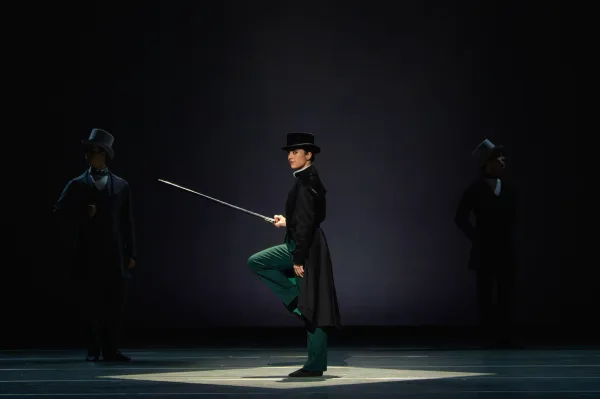
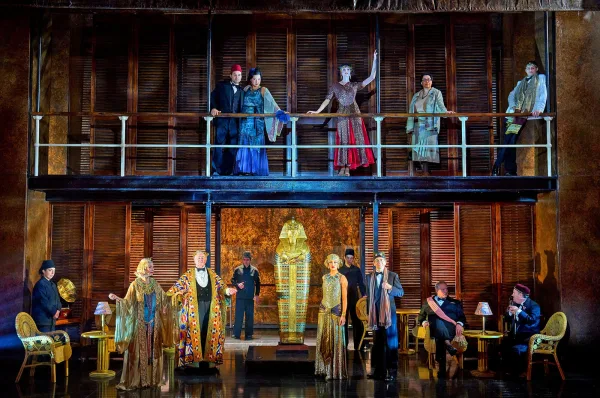
That said, it did afford probably the best view of Es Devlin's stunning set and the set pieces performed within it. After a technical hiccough that had us pausing for thought, the normally interminable play within a play was transformed into a haunting mime. Scene changes were populated with the ensemble cast skittering about with the stagecraft of a Matthew Bourne ballet. The closing scene, so often risible as the bodies pile up, was cleverly side-stepped by having those bodies disappear into oblivion.

Granted, there were missteps along the way. Polonius's off-stage departure was inexplicably anticlimactic for such a pivotal plot point. Had I been less familiar with the play, I don't think I would have understood what had happened. The gravedigger scene made so little sense, even within the context of metaphor, that I would have simply done away with it. Some of the lesser roles were delivered undercooked. The conclusion of the play benefitted from cracking pace, but did lack coherence as a result.
For the most part, however, this was a noble attempt to breathe fresh life into a play we know too well to enjoy as the author intended. It was a feast for the eyes and, with the text stripped to the bone, offered up an unusually urgent and fast-moving version of a play that, in the wrong hands, can be an exhausting and wearisome experience. Whether that justifies a staging conceit that strained credulity is a moot point.
I am reminded of a conversation between Jonathan Miller and Melvyn Bragg. Miller rather pompously explained, at length, the great significance of his decision to stage Der Rosenkavalier in modern dress.
"But they will still be singing the same songs," countered Bragg.
"Well, yes, of course," conceded Miller begrudgingly.
"So really, you're just deciding what hats they should wear."
Ultimately, the same could very much said here. For all the audaciousness, it's still Hamlet – yet again – just with some very fancy window dressing.
Dare I say it? This was close, but no cigar.