
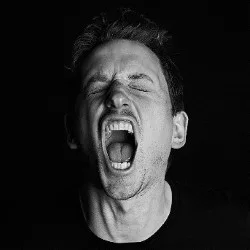
Vittorio Angelone
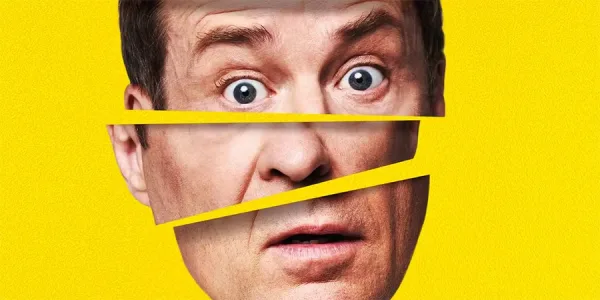
A very comfy chair seemed to exactly match a laconic, measured delivery that would surely have brought to mind the late, great Dave Allen even without the name drop. Throughout, he seemed so at ease I'd have assumed the upholstered support was part of his schtick — maybe it should be, given how well it seemed to work for him.

Vittorio Angelone's popularity — his sold-out evening performance had been preceded by a matinée — has had little to do with TV exposure. This amounted, as he was quick to outline, to of all things, Richard Osman's House of Games. As is the way these days, it's social media that has enabled him to fill the Playhouse twice over, meaning that those of us of a certain age get to see a relatively unknown comic who is nonetheless very popular with a certain demographic.
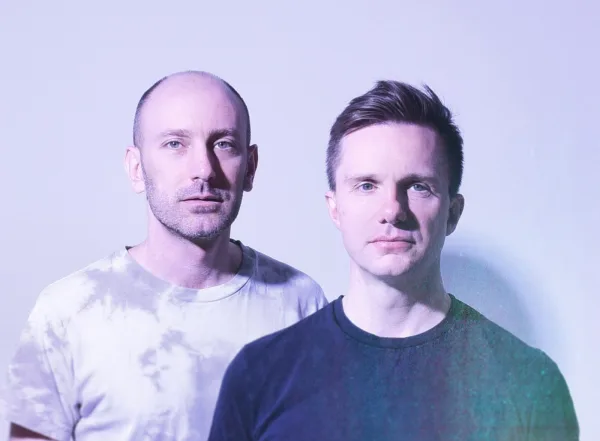
Beforehand, however, there was an unexpected bonus, and what a pity the Playhouse didn't think to mention that Rónán Stewart and Eoin Murphy from the Irish band Cúig were playing on stage prior to Vittorio Angelone's appearance. It was a delightful surprise to find this fiddle and accordion duo entertaining the crowd filling out the auditorium, but I — and I dare say many others — regretted hanging around the bar instead.
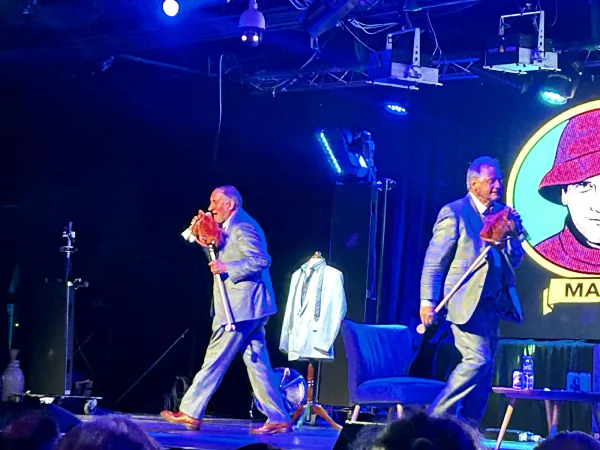
When Vittorio Angelone's official support did turn up, it turned out to be Vittorio Angelone. As seems to be increasingly the case, acts tour with a set designed to slot into the format appropriate for the likes of Edinburgh — clocking in at around the hour mark — preceded by a more informal chat. On this occasion, the poor chap was dosed up on ibuprofen and was hobbling on crutches, having fractured his ankle. Far from dampening his, or indeed our, spirits, a light-hearted chat with Max and Milly proved to be a diverting, if not stellar, comedic 20 minutes. Who knew that Hopton was a premier holiday resort? Certainly not the heckler who shouted "Shithole," one voice among many from a lively crowd, obviously at ease with a performer who is used to interaction being part of the deal.
That said, after the break there was a sharp gear change, and not just into the suit and tie he chose to dress up in. A very comfy chair seemed to exactly match a laconic, measured delivery that would surely have brought to mind the late, great Dave Allen even without the name drop. Throughout, he seemed so at ease I'd have assumed the upholstered support was part of his schtick — maybe it should be, given how well it seemed to work for him.

His routine started with some inconsequential chatter about moustaches and mullets that had me worried this might prove a long evening, and while he touched on the issue of mental health, there was still little of substance to get your teeth into. It was when he embarked on an extended routine — though that word belittles the precision with which he spoke — that revolved around the Troubles of his birthplace, Northern Ireland. Specifically, how do you negotiate coming from a place defined by conflict you are too young to know? This was involving stuff, and while peppered with some good gags — as a baby he was involved in dirty protests — his ruminations were consistently more interesting than the jokes. There's an expression, he explained, that young folk exclaim joyously, meaning nothing more than edgy rebellion. To an older generation, however, it's an endorsement of a notorious (depending on your inclination) terrorist/republican paramilitary organization. As someone much older than Angelone, I feel uncomfortable even writing "Up the Ra" down. For him, the phrase has been rehabilitated.
It was an age-based dichotomy that pervaded an evening that had him explain who Gerry Adams was, and now is, and who the Guildford Four were. Safe to say, some of this made me feel my age in a performance that was nonetheless engaging throughout. I particularly welcomed his acknowledgement of his own moral ambivalence, critical of comics performing in Saudi Arabia, while conceding he played in Dubai. It would be easy to accuse his message of incoherence — advocating freedom of expression yet markedly touchy when criticised — but this is probably best seen as emotional maturity. Easy answers on either side of a debate are probably blind to inherent complexity.
A case in point is an odd part of the show when he had a pop at Guardian reviewer Brian Logan. Few would argue with his central thesis that reviewers are the lowest form of life, but it did seem strange Angelone would go into quite so much detail about how Logan didn't understand subtext. I read Logan's review and it's one line in a generally positive report. Without jumping down the rabbit hole with the pair of them, Angelone's defence, that he spoke of "gay theatre" in a funny voice, epitomised a tendency to have his cake and eat it. If he didn't mean it critically — as was apparently evident from his tone — what did he mean? What exactly was the subtext? Presumably the target was folk that complain about the prevalance of gay people working in the theatre, but does that really land? Is that what the audience were really laughing at? For a performer that roots much of his act in the fabric of the last century, he will know that Irish jokes were a thing. Irishmen would feed breadcrumbs to helicopters, or stare at orange juice labelled concentrate, and the tellers of these jokes would insist they were said without malice, and perhaps even argue that the butt of their joke was the people holding these prejudices. I don't think those jokes are now missed.
Context and intent are important, but they're not a get-out-of-jail card. I won't spoil the end of his show, not least as he asked politely not to, but I hold the view it was crass and unthinking, and tempered my enjoyment of the show. However much language morphs with the generations, getting the audience to chant along to something they are too young to appreciate and yet which resonates uncomfortably with an older generation was problematic. I, no doubt, missed the subtext. I will say, however, I can imagine his counter-argument and acknowledge its legitimacy, and will happily concede this was for the most part, a thought-provoking evening that I'm still dwelling over. Better that, than the readily consumed and easily forgotten.