
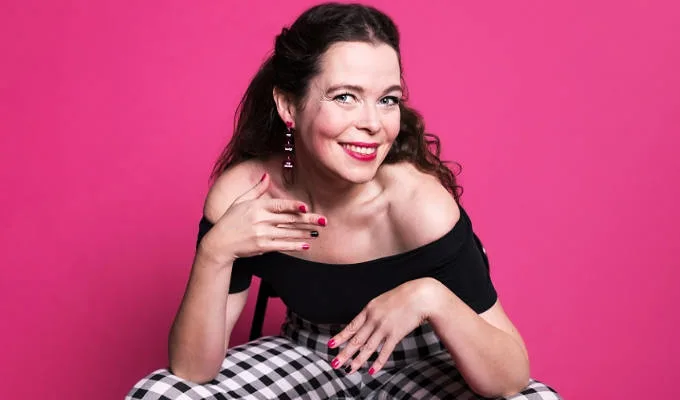
Juliette Burton: Hopepunk
Her gift, and it cannot be overstated, is to normalise what might otherwise be too traumatic to discuss, embracing not only her philosophy but her audience as well, so that the evening felt less like a performance and more like a conversation.
Theatre Royal
The auditorium of the Theatre Royal was crowded with folk on Saturday night, giddy with excitement at the prospect of enjoying the final, sold-out performance of Only Fools and Horses, one of several TV and film adaptations to rub shoulders with touring blockbuster musicals gracing the stage of Norwich's largest theatrical venue. It's a little miracle that the Royal continues to attract healthy audiences in these challenging times and a matter of practical necessity that, to do so, a heavy emphasis is placed on crowd pleasing spectacle and cosy familiarity. It makes it all the more impressive that the Royal has chosen to offer up an alternative space for productions unlikely to garner a large audience, and Stage Two, tucked around the corner and reached by a brief but nippy walk across a rear courtyard, hosts a bewildering variety of niche productions in an intimate setting that makes even the Playhouse look cavernous by comparison. Despite the undoubted pleasures of Del Boy and Rodders in the main space, it was a treat to instead spend an evening in the company of Juliette Burton.
It struck me that Burton performs in front of two audiences each night, those who have seen her before and newcomers unprepared for the hand break turn the show will, at some point, take. I first saw her perform at the Edinburgh Fringe close to ten years ago, where she invited her audience to Look At Me. I expected a feather-light exploration of narcissism and a welcome sorbet to the relentless coruscating drama I had been inflicting upon myself elsewhere. In fairness, it started off that way, as did last night's run through of Norwich fun facts, which served as a quasi-support to a show she repeatedly assured us hadn't started yet.
What followed however, back in 2014, was a bold treatise on body consciousness that rested, in no small part, on the fulcrum of Burton's own mental challenges, confounding an audience expectation informed by her breezy self-confident delivery. A stalwart of Edinburgh ever since, she's one of many performers that it's easy to imagine exists only within that bubble. Just as the likes of Ed Aczel, Lucy McCormick and Tim Honnef must have lives and careers beyond the Fringe, it’s nevertheless easy to imagine they, along with Burton, being cryogenically frozen each year, only to be thawed out to talk about decisions, kindness and in the case of this show, hope. I was fascinated to see how one of hers would play out in the real world, as it were, in front of an audience less familiar with her work.

Hopepunk, I presume, premiered in Edinburgh where her regular audience would have been aware of the baggage carried, and so perhaps she feels she's spoken enough about her mental fragility - perhaps she has grown weary of addressing it. Whatever the reason, in this show she placed a greater emphasis on stand-up comedy, with gags aplenty weaved into the fabric of her overall theme of hope. Newcomers will surely have been wrong footed by the revelation that she has been diagnosed with no less than fifteen mental conditions, but I got the sense she was less inclined to travel far down that road. Instead, we were introduced to bar charts, graphs and all manner of nerdish illustrations inviting us to consider our glasses to be half full. The jokes she cracked registered smiles and chuckles, but tellingly the biggest laughs came from audience interaction, at which she excels. After all, jokes are not what sets Juliette Burton apart. She is, for a start, great company, and has the ability to draw positivity from her audience, so that while we may not howl with laughter, we nonetheless warm to what she has to say. In short, everyone has a jolly nice time.
If that sounds like a back handed compliment then banish such thoughts from your mind. Solo theatre production increasingly focuses on introspective reflection, but whereas in other hands this can lapse into self-indulgence, Burton turns her back on maudlin self-pity. We were told, point blank, not to view her as brave, but rather to see her circumstances as merely aspects of an otherwise (and in all other respects) normal person. To talk so frankly, and yet so engagingly, about matters so often swept under the carpet requires charisma, empathy and straightforward decency, characteristics she has in spades. Her gift, and it cannot be overstated, is to normalise what might otherwise be too traumatic to discuss, embracing not only her philosophy but her audience as well, so that the evening felt less like a performance and more like a conversation.
It's a testament to her ability to have held our attention that having closed on an typically self-deprecating anecdote about Mountain Warehouse, it was astonished to realise a show advertised as an hour had overrun by another 45 minutes. Had the theatre not required us to leave, I got the sense she'd have happily gone on even longer. I also got the sense the audience would have happily stayed to listen.