Weathering With You
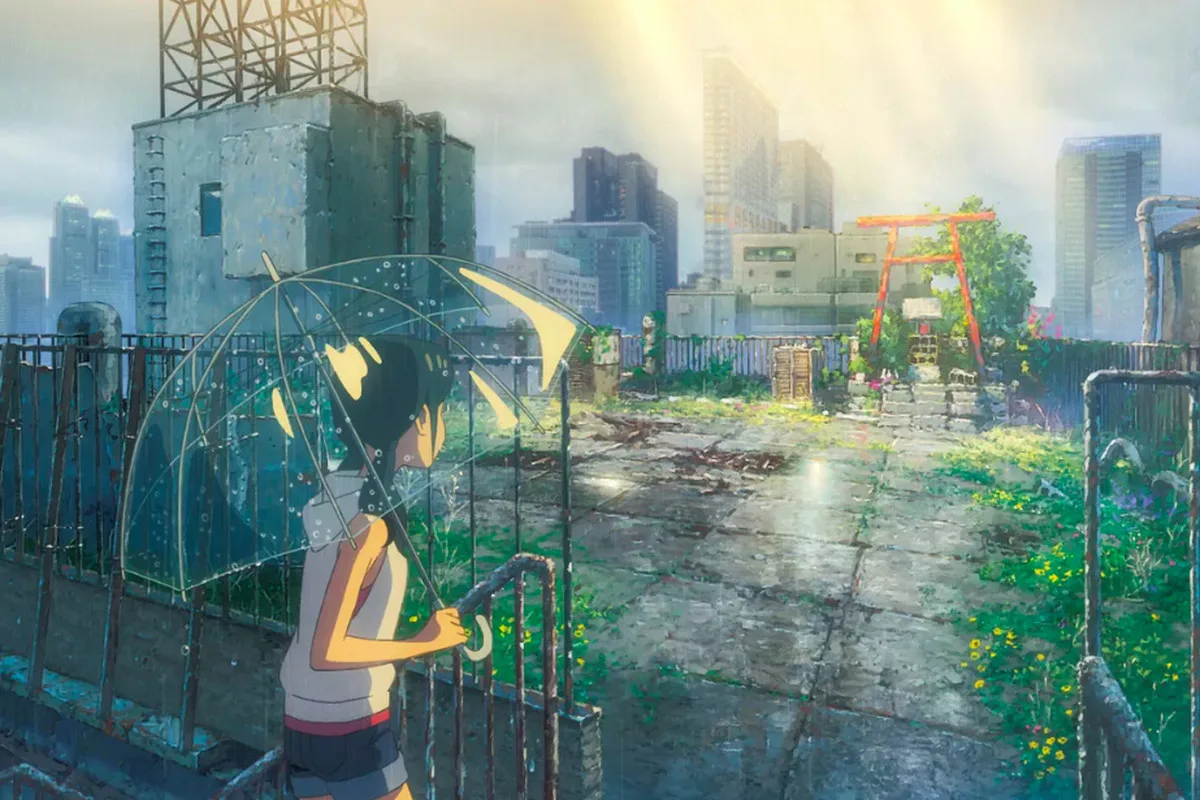
It’s been raining non-stop in Tokyo for weeks, and there’s no signs of stopping. 16 year-old Hodaka Morishima – a runaway – arrives in the drenched city without no job nor place tosleep, and is taken in by Keisuke Suga, who puts him to workwriting articles about urban legends and the paranormal. Hodaka later meets and falls for Hina Amano, a young girl with the power to stop the rain and bring sunshine back toTokyo. It’s a “boy meets girl” premise that is joyfully more inventive than what we often get in the west, which is generally more “I’m not popular but my crush is, this is truly a tragedy of epic proportions” than “I fell in love with a girl with divine powers, but does playing god have consequences? Also the police are after me because they think I’m involved in gang violence.” Say what you will about anime, it’s certainly got bold premises.
A pre-recorded FAQ with director Makoto Shinkai that played before the film expanded on the recurring sky-imagery in his films coming from his childhood, where he would apparently spend hours just watching staring upwards, watching as the colours changed and the stars emerged. Weathering With You’s fantastical depictions really get across that sense of wonder Shinkai describes seeing, and the mythologizing of the sky is one of the film’s most interesting aspects. The film is like a modern folktale, with a love story placed against the background of Hina’s status as a “sunshine girl” and theconnection she shares with the heavens.

The film occasionally philosophises on the effect weather has on us, and maybe its poetic in its original language, but it fell flat for me. Taking a moment out of the film and story to have the protagonist glibly say something in the vein “man, doesn’t sunshine make you happy?” feels a bit pointless and an attempt at a depth the film doesn’t have.
I’m not sure if it’s a trope of the genre, but the parts where the movie will just stop and transition to a montage set to a Japanese pop song, that’s always jarring.
The movie’s ending is similar to Shinkai’s previous, Your Name (whose protagonists make cheeky cameo’s in this film), but is less satisfying at the end of this particular story. Despite liking the premise, animation, characters etc. I encountered the same problem I had with Your Name, despite loving the parts, I didn’t love the whole, and left the cinema wanting. It feels like everything it approaches – the romance, the mystical elements, our character’s arcs and struggles – are only ever surface level interactions, and although there’s some fantastic moments throughout and I was rarely not enjoying myself, Idoubt I’ll revisit.