
Peggy Seeger
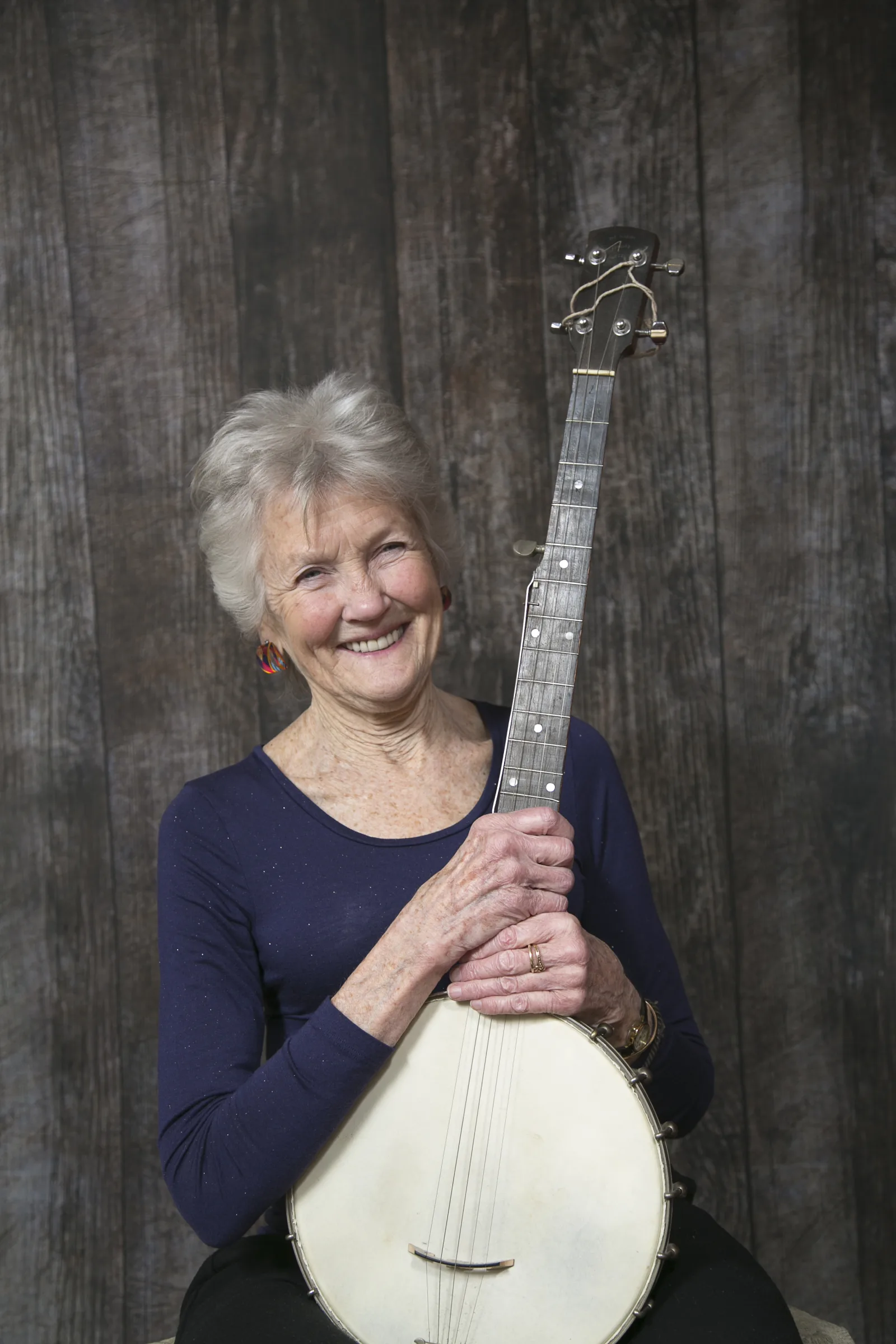
Peggy Seeger is a legend in her own lifetime. Playing piano, guitar, banjo, autoharp, dulcimer and concertina, she was sister to Pete Seeger, one of the most important folk singers of all time, and stepmother to Kirsty MacColl. Now in her 80’s, Peggy started her career back in the 50’s, with proto feminist song Gonna Be An Engineer. Always an activist and busy working on maintaining the importance and heritage of folk music throughout her life thus far, she’s also released 21 solo albums and many more duets with her husband Ewan MacColl. Now she lives in Oxford, has a female partner and has just written her autobiography, allegedly full of controversies and truths. She’s coming to Epic for a night of readings and music alongside two of her sons, also musicians. I had the honour of speaking to her about folk as entertainment, how she felt about her husband writing First Time Ever I Saw Your Face about her and her memories of Norwich.
You’re heading out for a 20 date concert tour and literary festivals soon. You’re now in your early 80’s – how has your singing and playing changed as you’ve aged?
I started out as a very straight singer – when I got on stage I sang the songs as best I could, trying to be faithful to the way I had heard the songs, folk songs that is. It’s possible I might have been taken as what they called a field singer. The real folk singers were mainly working class but I had had a classical education which did affect me. It was piano that I trained in, so I didn’t sing like a classical singer but it did have an influence. I’ve been singing for 60 years and there are certain songs that I’ve played literally hundreds of times in my life, and it’s possible to get bored with them, but also it’s possible that singing them straight and almost unemotionally won’t do when you’re singing them for a community of people that have come from a different background. You have to become an entertainer. It’s a one off experience between people who don’t know each other, and that’s very different from the fact that a singer in the old communities, where these folk songs were made where they would know everyone in the room, and the people in the room would know the people as well as the singer did. That doesn’t happen when you become a performer and travel from one city to another, so you have to develop ways of keeping yourself interested, of not feeling like the audience is hostile when you come onstage, avoiding the pranks that your own ego plays on you…it’s very very different. Folk songs were not created to be sung on stage to strangers, unlike pop or classical or music hall. So I became an entertainer, hopefully a restrained one.
<iframe src="//www.youtube.com/embed/8IGVxBb5uYk" width="560" height="315" frameborder="0" allowfullscreen="allowfullscreen"></iframe>
You and family members performing your husband’s and your songs– your sons are both playing with you – how do you go about choosing what to play, and how do you get on working together?
Oh yes, isn’t that wonderful? It is so hard to choose what to play because between the three of us we literally know hundreds of songs. They usually leave the choice to me but on this tour I want them to sing some songs themselves. On their last tour each of them sang two songs – I’d like them to sing four songs each and I’d do backing vocals or just sit and listen because they are both beautiful singers and lovely instrumentalists. I have some new songs also, written with my son Neil’s wife, and some with my son Callum. The boys are both in their 50’s now so we’re all getting on!
How did you find writing your memoir?
I’ve been involving in assembling anthologies of songs in the past but never been involved in writing a book. It’s out in October. It’s not only about my life and what I remember but also about what I think about things, and of course what you think about things develops as you get older. I have a visual memory that holds literally thousands of photographs of different events in my head almost as if it’s a camera. I’ve drawn on those quite a bit, but being honest, Lizz, I found it emotionally gruelling. Reading over the trial bound copy I think it’s good, it says what I want it to say but I’m opened myself up a lot and laid myself on the line and there are going to be people writing to me outraged at some of the things I did and said so I have to be prepared for that. But I’m 82, I won’t live past a lot of other people’s reactions to it, and I’ve written what I thought was important. I felt that I didn’t want to be secretive about my life – people think because you get up on stage you’re some kind of special being. Well, you’re not – you’re just a person with a bigger ego that other people! So one of the things I’m trying to do is to close the gap and say look, in reality I’m just like you, I shit, I fart, I piss, I fall in love, I’d done things I’m ashamed of, there are things I shouldn’t have done, and maybe you have too. We’re all the same in the end. It takes a lot of courage to get on stage and some people still have horrendous nerves, they suffer. But you suffer not for your art but because of the urge you have to be there, so the memoir is to close the gap and also so people won’t have to interview me anymore, ha ha ha!
<iframe src="//www.youtube.com/embed/TbB4JVARjdc" width="560" height="315" frameborder="0" allowfullscreen="allowfullscreen"></iframe>
Can you tell me a bit about the Critics Group that you and Ewan ran?
Ewan MacColl was my first life partner for 30 years, and we had a group that we worked with called Critics Group, whose purpose was to help people to sing traditional songs if their main form of music from childhood was not folk music. If you’d been brought up singing pop, music hall or anything else you’d perform a traditional song differently. Traditional music is very different to other forms as it springs out of community and the working class community, so they’re generally sung without pretention or any external stylistic components put on them. They are songs not made for patronage or money. With the Critics Group, one of the ways we helped to teach the mostly city people was that we used theatre techniques – ways to use your imagination when singing these songs, and looking at the attitudes you have towards yourself and the place where these songs came from.
Did you come up against criticism for some of the subject matter of your songs like feminism and domestic violence, especially during the early days?
I wasn’t trying to make those issues more public, I was writing songs that I felt needed to be written. A lot of the reception of the songs depends on what they were about, but now it seems there are no forbidden subjects. The only sexual subject that hasn’t been outed is masturbation, but we’re getting there!
<iframe src="//www.youtube.com/embed/nRUXCHZK2rs" width="560" height="315" frameborder="0" allowfullscreen="allowfullscreen"></iframe>

Folk music often sees the same song sung by different people, in a way that doesn’t happen so much in other genres. That must have been interesting to hear other people hear your songs like your brother Pete singing Gonna Be An Engineer.
Well there are different versions of songs because they travel. They landed in different economic circumstances, a different mix of people…as far as Pete singing Gonna Be An Engineer, he didn’t like long songs so he cut out the sections in minor keys. I pointed out to him that he’d cut out society’s response by doing that, and he was horrified when he learned that! Mind up, he made some wonderful songs, more singable by more people than mine. A lot of people change a song because they just don’t listen properly. The tune that you hear on Roberta Flack’s version of The First Time Ever is not the tune that Ewan wrote, for example. It’s very different. Nonetheless I collect the royalties so I don’t care!
Ewan wrote First Time Ever I Saw Your Face about you. When he first played it to you, how did you feel?
Oh good lord no. I thought it was a pretty song and I sang it as such for the first three or four years. I was quite embarrassed singing it onstage, that third line “the first time ever I lay with you” with Ewan sitting there right next to me probably chortling away, but everyone’s going to get a very different idea of the first night we actually spent together from my memoir, and I’m not giving you any spoilers.
<iframe src="//www.youtube.com/embed/cXYPb0rrwbA" width="560" height="315" frameborder="0" allowfullscreen="allowfullscreen"></iframe>
You are now in a civil partnership with Irene, an Irish singer. How did you meet, and have you and Irene ever recorded anything together?
Oh, we made a whole CD together called Almost Commercially Viable, and it has its own story. She sang very traditional songs but she doesn’t sing any more. She lives in New Zealand and we see each other six months a year. We’re still together but apart. We haven’t sung together since 1993..we called ourselves No Spring Chickens and formed a record company. It was a period of life.
You’ve lived in Oxford for some years now. What do you miss about the States?
I miss the informality of American people. Sometimes it can be too informal too quick – if the bank manager hugs you, for example! But I’m completely at home in both countries, and both have something the other doesn’t have. I came back because I grew up here aged 24 to 54. I know this country, I don’t know America – I was away too long, for 35 years. It would be a real challenge to be in America right now.
Which modern singers do you admire?
Well now here’s a shocker – I don’t listen to a lot of music, chiefly because if I hear music I have to stop thinking about anything else and I have a very busy life, and I’m very hard to please with music. I listen to music from the 30s and 40s, and I love country and western. I like music that has good tunes and good words, and a huge amount of the music being presently made, I can’t understand the words because there’s so much instrumental noise with it. As far as folk music is concerned, one of my favourites is Sam Lee, he’s an excellent singer of folk songs. I like Tom Paxton too.
<iframe src="//www.youtube.com/embed/22t6FAoyv5o" width="560" height="315" frameborder="0" allowfullscreen="allowfullscreen"></iframe>
Is there anywhere in particular you’re looking forward to visiting on this tour?
Well I will say that Norwich has always been one of my favourite towns – I loved it from the first time I saw it. One of my dearest memories is that we bought our 52 volume set of Balzac’s Comedie Humaine from a secondhand bookshop in Norwich, a Caxton edition. It’s absolutely beautiful, I’ve read it all three times. That’s what I’m taking to my desert island! The centre is pedestrianised now isn’t it? I don’t know if we’ll have time to look round this time – it’s a shame that generally you don’t see where you actually go on tour.
Peggy Seeger plays at Epic on 26th October. Tickets available from ueatickets.ticketabc.com